
FRS 102: Everything you need to know about upcoming changes
by Prophix
Significant updates to FRS 102, the financing reporting standard for the UK and Ireland, are on the horizon. This blog post outlines who will be affected, when the changes take effect, and what businesses need to know to stay compliant.
What is FRS 102?
FRS 102 is a financial reporting standard developed by the Financial Reporting Council (FRC) for the UK and Republic of Ireland. The first version of FRS 102 was published in 2013 and came into force for accounting periods beginning on or after January 1, 2015, marking a significant step in aligning UK and Irish GAAP with international financial reporting practices. Since then, the standard has been subject to review approximately every five years, with the first review happening in 2017 with an effective date of January 1, 2019 and the second and last review, to date, happening in 2024, effective as of 2026.
Who has to be compliant with FRS 102?
FRS 102 applies to entities in the UK and Ireland that are not required to use IFRS. This includes:
- Medium and large private companies
- Small and medium enterprises that are not classified as micro-entities
- Non-public sector entities such as charities and partnerships
Entities not using FRS 102:
- Listed companies (IFRS compliant)
- Micro-entities (FRS 105 compliant)
- Subsidiaries and parent companies in groups that qualify for reduced disclosure requirements (FRS 101
When does FRS 102 come into effect
The latest amendments to FRS 102, resulting from the 2024 periodic review, must be implemented for accounting periods beginning on or after January 1, 2026. Companies are allowed to implement the standard earlier, but only if they apply all amendments at once.
Key changes for FRS 102 Presentation and Disclosure in Financial Statements
FRS 102 is very broad, with each update following the original structure of 35 sections, covering different aspects of the reporting requirements. For the purpose of this blog, we will focus on the most impactful changes introduced with the 2024 update.
What does FRS 102 replace?
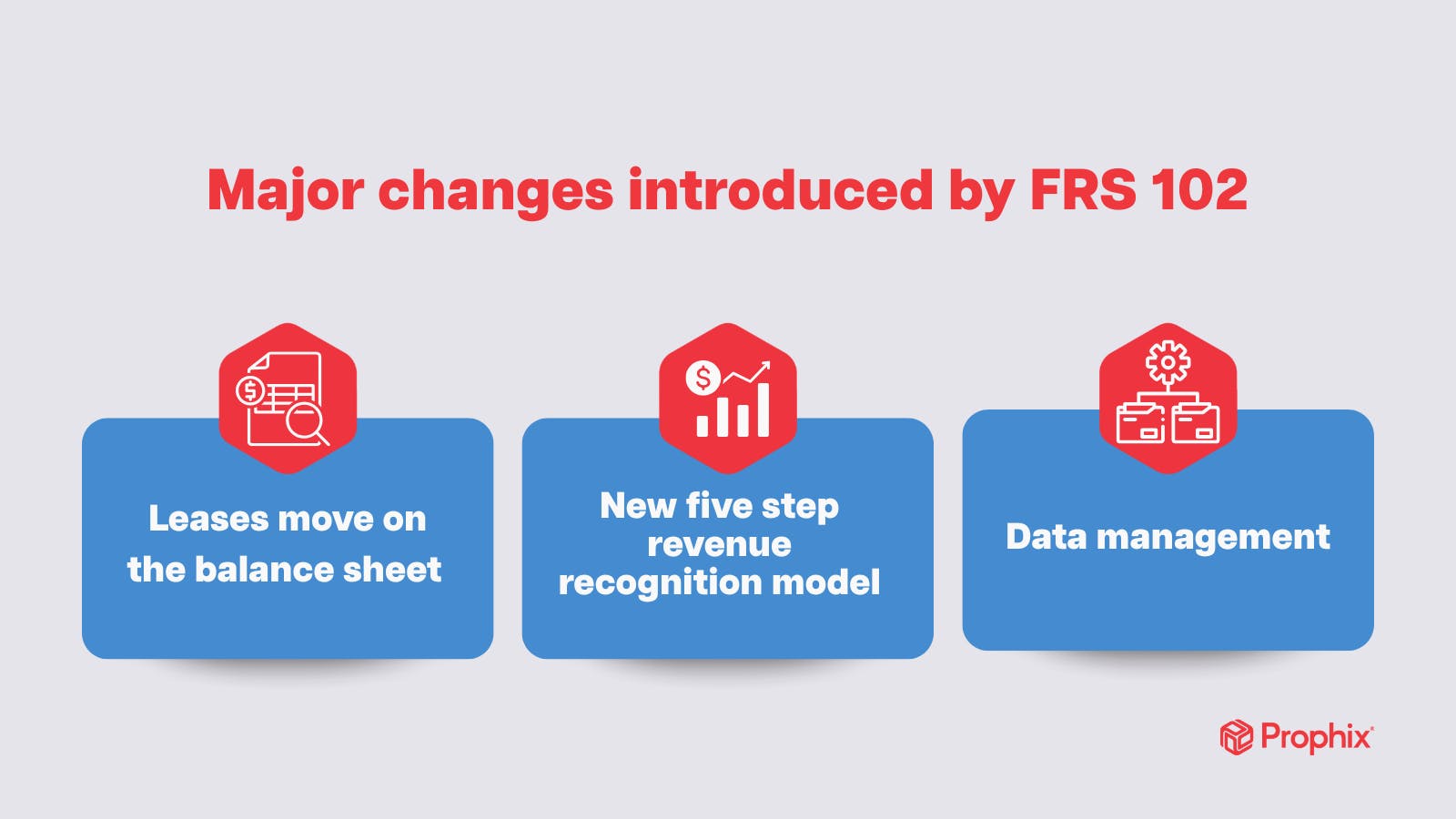
The new update introduces changes significantly affecting lease accounting and revenue recognition requirements, aligning FRS 102 more closely to IFRS 16 and IFRS 15 respectively.
Leases move on balance sheet
What’s changed:
The updated standard requires that most leases are recognized on the balance sheet, instead of simply being recorded as an expense. This is a significant change that will increase both assets and liabilities, affecting key financial metrics like EBITDA, debt covenants, and gearing ratios. Needless to say, the standard will introduce greater visibility in the obligations of organizations
Impact:
Lessees will now have to recognize two new items on their balance sheet:
- Right-of-use asset: Reflecting the lessee’s right to use the leased asset throughout the lease term.
- Lease liability: Reflecting the present value of future lease payments owed.
Exemptions:
The following smaller or simpler leases are excluded:
- Short-term leases: Terms of less than 12 months
- Low-value assets: Value below approximately £5,000 (new price)
Another aspect of the changes to lease accounting is the broadening of the term ‘lease’. Contracts that have been previously classified as service agreements or supplier contracts
with embedded leases are now seen as a lease which could be potentially recognized on the balance sheet. This means companies will have to review their existing supplier contracts to determine whether they meet this new definition of a lease.
These changes can pose challenges, including:
- The need to review and potentially reclassify existing supplier contracts.
- Increased focus on leases means errors and misstatements are more consequential and costly.
- Managing lease tracking and modifications manually becomes even harder due to the increase in lease numbers (resulting from the reclassifications) and increased disclosure requirements. Lease accounting software can help to overcome this challenge.
Why it matters:
While this change improves transparency in financial reporting, it also increases the complexity of lease management and can have a significant effect on reported results, making early preparation essential to compliance.
New five step revenue recognition model
What’s changed:
The updated FRS 102 standard introduces a comprehensive five-step model for revenue recognition, similar to IFRS 15 and ASC 606. In the past, the standard provided guidance which was more flexible. This would lead to inconsistencies in how different companies recognized revenue. According to the updated standard, companies must recognize revenue based on the transfer of control, not just the transfer of risks and rewards.
Here is the new five step revenue recognition model:
- Identify the contract(s) with a customer: Contracts must be enforceable and may need to be combined if they are negotiated as a package.
- Identify the performance obligations: Companies must break down contracts into distinct goods or services promised to the customer.
- Determine the transaction price: This can include fixed amounts, variable consideration, discounts, and rebates, and must be estimated carefully.
- Allocate the transaction price: The price is allocated to each performance obligation based on relative stand-alone selling prices.
- Recognize revenue as obligations are satisfied: Revenue is recognized when (or as) control of the good or service passes to the customer, which may be over time or at a point in time.
Impact:
Similar to the updates in lease accounting, this change has a positive impact on the transparency, reliability, and comparability of financial reporting. It adds clarity on the nature, amount, and timing of revenue and cash flows. At the same time, it also requires companies to exercise more judgment, especially when identifying performance obligations, estimating variable considerations, and determining when control has transferred.
This update results in the following challenges:
- Contract complexity: Contracts often bundle goods and services, requiring careful unbundling and allocation of prices.
- Judgment calls: Assessing when performance obligations are satisfied and how to estimate variable pricing can be difficult and subjective.
- Process overhaul: Companies may need to collaborate across departments (e.g., sales, legal, finance) to ensure contracts are structured and interpreted correctly under the new rules.
- Potential restatements: The timing and amount of revenue recognized may change, impacting reported results and possibly requiring communication with stakeholders and lenders.
Why it matters:
This updated standard, while still less complex and detailed than IFRS 15, does provide more structure and guidance around revenue recognition, thus improving the reliability of information around the nature, amount, and timing of revenue and cash flows from customer contracts.
Data management
What’s changed:
The new FRS 102 requirements dramatically increase the volume and complexity of data that companies must collect, analyze, and manage. This applies to both lease accounting and revenue recognition, as well as other updated areas such as fair value measurement, supplier finance arrangements, and share-based payments.
Impact:
- Data extraction: Companies must review and extract key information from potentially hundreds or thousands of contracts to identify leases and performance obligations.
- Ongoing management: Lease terms, contract modifications, and revenue arrangements can change frequently, requiring continual updates and re-evaluation.
- Manual processes under strain: Many organizations initially rely on spreadsheets for transition, but these often become unmanageable as complexity grows—especially when dealing with contract changes, remeasurements, and recalculations.
- Audit trail and compliance: Enhanced disclosure and documentation requirements mean companies must maintain robust audit trails, supporting all key judgments and calculations.
Implementation challenges:
- Resource intensity: The transition requires significant time and expertise from finance, accounting, legal, and IT teams.
- Technology needs: Manual systems may not suffice; automation, AI-driven contract analysis tools can accelerate compliance and reduce errors.
- Change management: Staff training, stakeholder communication, and process redesign are essential to ensure smooth adoption and ongoing compliance.
Why it matters:
Effective data management is crucial for compliance with new standards. Expanding the requirements around data collection and analysis will further align organizations and ensure consistency in reporting.
Risks of inadequate preparation
There are risks if you are not prepared for the FRS 102 changes that will take effect in 2026. Here is a summary of risks:
- Financial reporting errors and compliance issues
Failing to properly implement the new FRS 102 requirements, especially the new lease accounting and revenue recognition models, can lead to misstatements in financial statements. This means there is increased risk of audit failures, regulatory penalties, and reputational damage. - Impact on key financial metrics and covenants
Bringing leases onto the balance sheet and changing revenue recognition can significantly alter reported assets, liabilities, EBITDA, and other key ratios. If companies are unprepared, these changes may cause breaches of loan covenants, pension agreements, or executive remuneration targets. - Data management and process failures
The new standards require extracting, analyzing, and managing large volumes of contract data. Relying on manual processes (like spreadsheets) can quickly become unmanageable, leading to errors, omissions, and difficulties in maintaining accurate audit trails. - Poor stakeholder communication
If other departments, lenders, or investors are not informed about the impact of FRS 102 changes, misunderstandings and disputes may arise – especially if financial results or covenants change unexpectedly. - Increased pressure on resources and time
Delaying preparation can force companies into a rushed transition, increasing the likelihood of mistakes, missed deadlines, and staff burnout. Late adoption also reduces the time available for testing new systems and training staff. - Judgment and complexity challenges
The new rules require more qualitative judgments (e.g., identifying embedded leases, unbundling performance obligations in contracts). Inadequate preparation can lead to inconsistent or incorrect application of the standards.
Inadequate preparation for FRS 102 can result in compliance failures, financial misstatements, breached covenants, operational inefficiencies, and increased risk of audit issues. Early planning, robust data management, and clear communication are essential to manage these risks effectively.
How Prophix can help companies prepare for FRS 102 changes
With Prophix One, you have automation and unified data at your fingertips. Not only will this reduce manual work and spreadsheet chaos, but it will help you transition to the updated FRS 102 requirements with compliance top of mind.
- Centralized data management:
Collect, organize, and maintain all lease and revenue contract data in a single, secure platform. This reduces the risk of errors and ensures that all relevant information is easily accessible for reporting and audit purposes. - Automated calculations:
Complex calculations may be required under the new standards, such as recognizing right-of-use assets, lease liabilities, and applying the five-step revenue recognition model, but Prophix One is enabled to support this. This minimizes manual effort and helps ensure accuracy. - Automated lease modification handling:
Easily process lease modifications, such as changes in lease terms, rent adjustments, or scope alterations. Our lease accounting software automatically recalculates right-of-use assets and lease liabilities in accordance with accounting standards, ensuring accurate financial reporting. - Enhanced audit trails and documentation:
By tracking all changes and maintaining comprehensive documentation, you will have robust audit trails, which are crucial for compliance with new, more detailed disclosure requirements. - Scenario analysis and impact assessment:
Model the impact of FRS 102 changes on key financial metrics, such as EBITDA and gearing ratios, so you can anticipate and manage the effects on covenants and stakeholder expectations. - Improved collaboration:
Bring all of your key players together – whether it’s finance, accounting, or other departments – to ensure everyone is aligned and informed throughout the transition process.
The truth is, changes are happening. FRS 102 comes into effect in 2026 and there’s no better time than now to ensure you’re ready for this transition. With Prophix One, you can efficiently manage the increased complexity of FRS 102, reduce compliance risk, and free up your time to focus on strategic analysis rather than manual data processing.
Learn how to future-proof your financial reporting
Book Demo